
Some murder mystery settings stay with readers long after the final chapter. The most memorable one from my youth featured in Conan Doyle’s The Hound of the Baskervilles. Dartmoor offered the perfect blend of beauty and menace, and Conan Doyle understood how naturally readers would accept the West Country moors as the setting for such a dark mystery.
Further west lies Cornwall, another county that seems to go hand in hand with crime. Then, on the long journey home, we pass through the Roman city of Bath. These two places could hardly look more different, but as murder mystery settings, each gives a writer atmosphere, history and plenty of room for secrets.
Cornwall: Smugglers, Storms and Suspicion
Cornwall almost feels designed for crime fiction. Rugged cliffs plunge into crashing seas, fishing villages cling to the coastline, and storms can cut communities off from the outside world overnight. It’s dramatic, atmospheric and full of natural tension.
The county’s long history of smuggling adds another layer of intrigue. Hidden coves, sea caves and isolated beaches practically invite stories involving contraband, secret meetings or bodies washed ashore by the tide.
Cornwall’s coastline creates endless opportunities for mystery because the sea itself is unpredictable. It gives, and it takes away.
But Cornwall’s real strength lies in its contrasts. During summer, towns bustle with tourists, noise and colour. Out of season, many places become quiet and exposed, with empty streets and windswept harbours.
That shifting mood suits crime fiction perfectly. A setting that feels welcoming by day can become deeply unsettling after dark.
The landscape also creates emotional intensity. Clifftop paths, isolated cottages and endless horizons give stories a cinematic quality. Characters can feel trapped despite all the open space around them.
As with the rest of the West Country, community matters. Small villages remember everything. Outsiders stand out immediately. Rumours spread quickly, while old feuds never entirely disappear.
In Cornwall, the past is never very far away. In crime fiction, that usually means trouble is close behind.
Readers are spoilt for choice here. One of my favourite authors, Sally Rigby, has created a Cornwall Murder Mystery series featuring Detective Lauren Pengelly. It is well worth exploring if you enjoy coastal investigations and close-knit communities with secrets to hide.
It is easy to see why Cornwall remains one of Britain’s most compelling murder mystery settings.
It’s a long drive from Cornwall. We’re almost home now, passing through the Roman city of Bath.

Bath: Elegant Streets and Dangerous Secrets
Jane Austen walked these streets, yet Bath has also become home to countless murder mysteries. Its polished appearance gives crime writers something particularly useful: respectability behind which dangerous secrets can hide.
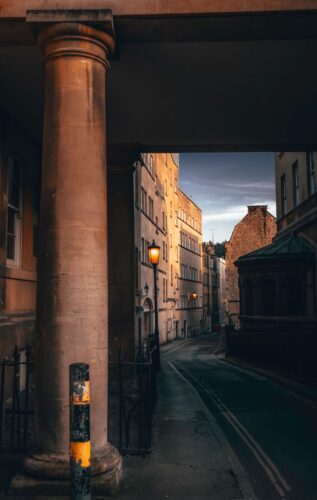
Bath seems built for classic detective fiction. Its Georgian crescents, cobbled streets and grand architecture create an atmosphere of refinement and order. But crime fiction has always loved places where appearances deceive, and beneath Bath’s elegance lies endless potential for intrigue.
The city’s history adds depth to every story. Ancient Roman baths, hidden passageways and centuries-old buildings give writers layers to explore. A modern investigation can suddenly uncover something buried in the past, linking a present crime to a forgotten scandal or long-hidden motive.
Bath also offers a different kind of tension from a rural mystery. Here, danger hides behind respectability.
Wealthy residents, academics, tourists and professionals all move through the same polished world, where reputations matter and secrets are carefully protected. That makes betrayal feel sharper and motives more personal.
The city’s layout helps too. Quiet side streets branch away from busy shopping areas, while alleyways and hidden courtyards create natural spaces for clandestine meetings or shadowy pursuits. A suspect can vanish into a crowd just as easily as into darkness.
What makes Bath especially effective is the contrast between beauty and unease. Readers expect calm and sophistication, which means crime lands with greater impact.
A murder in a lonely farmhouse is unsettling; a murder behind the perfect Georgian façade feels positively chilling.
Bath proves that crime fiction doesn’t always need bleakness. Sometimes polished surfaces make the darkness underneath even more compelling.
Murder at the Roman Baths by Jean G. Goodhind is one of the cosy mysteries featuring hotelier Honey Driver. It suits the city perfectly and is well worth a look.
Why These Murder Mystery Settings Stay with Readers
Cornwall and Bath work for opposite reasons. Cornwall uses isolation, changing weather and the unpredictability of the sea. Bath hides danger behind history, order and respectability.
Together, these murder mystery settings show how strongly a location can shape a story. The best settings do more than provide scenery. They influence the mood, affect the characters and sometimes become every bit as memorable as the detective investigating the crime.
If you’re eager to explore more mysteries inspired by the West Country, why not take a look at The Freeman Files or The Phoenix Series? There’s something there for everyone.
Another book related topic in early August. Not long to wait!
Best wishes
Ted Tayler